
Ultimate Multi-Agent System Orchestration Challenges Guide 2026
You are designing complex AI systems, striving for both efficiency and robust performance. Does distributing tasks across multiple specialized agents always result in an orchestrated symphony, or does it risk devolving into chaos? Navigating multi-agent system orchestration challenges requires deep architectural insight. You might be experiencing agents contradicting each other, falling into infinite loops, or over-delegating tasks, undermining the very reliability you aim to build.
This guide provides a strategic framework for understanding when and how to implement multi-agent AI architectures effectively. You will learn to identify the critical trade-offs between a single, powerful agent and a distributed network. We address common failure modes directly, offering architectural best practices that prevent these pitfalls. Equipping you with these strategic insights, this article helps you design and manage resilient, high-performing multi-agent systems.
What You Will Learn
- Identify appropriate scenarios for implementing multi-agent systems.
- Recognize and prevent common failure modes such as agent contradictions and infinite loops.
- Implement architectural best practices for designing robust multi-agent AI systems.
- Strategically evaluate the trade-offs between single powerful agents and distributed architectures.
- Develop a framework for proactive multi-agent system management.
A Strategic Guide to Multi-Agent System Architecture
Designing effective multi-agent systems requires a structured approach. Simply dividing a problem does not guarantee superior performance over a powerful single model. Success hinges on precise architectural decisions and a deep understanding of agent interactions. Here are key steps to implement a robust multi-agent architecture.
- Define Clear Agent Responsibilities: Assign each agent a specific, bounded task. Ambiguous roles lead to overlapping work, missed objectives, or internal conflicts. A well-defined scope ensures focused execution and simplifies debugging.
- Establish Robust Communication Protocols: Agents need to exchange information efficiently and reliably. Standardized message formats and clear communication channels prevent misinterpretation and latency. Design for both synchronous and asynchronous interactions as appropriate.
-
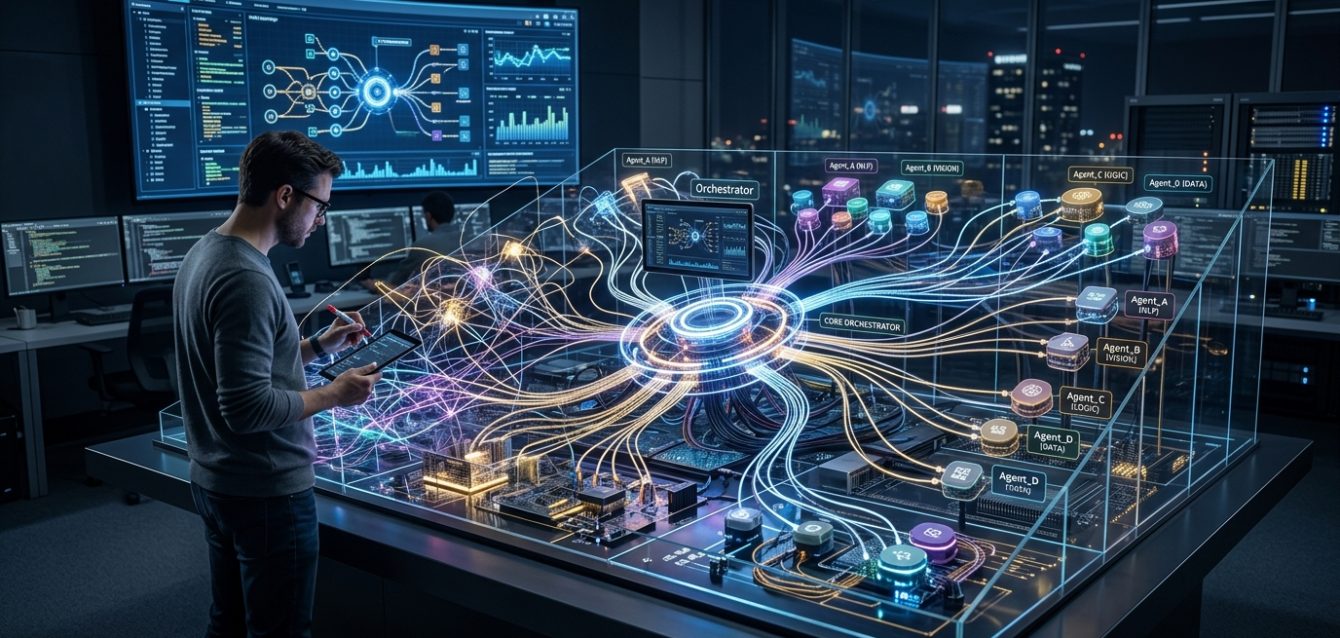
Implement a Centralized Orchestrator: A dedicated orchestrator manages the overall workflow, directs task delegation, and resolves discrepancies among sub-agents. This central point is crucial for controlling the system’s global behavior and understanding
how to orchestrate multi-agent AI systems
effectively.
- Design for Conflict Resolution: Inherent to multi-agent systems is the potential for conflicting outputs or resource contention. Build mechanisms into the orchestrator to detect and resolve these conflicts, ensuring system cohesion and objective alignment.
- Prioritize Observability and Monitoring: Understanding agent behavior and interaction patterns is vital. Implement comprehensive logging, tracing, and monitoring tools to visualize workflows, identify bottlenecks, and diagnose issues in complex distributed systems.
Tips for Designing Robust Multi-Agent AI Systems
Building an AI system where multiple entities collaborate presents unique challenges. Applying proven architectural principles can greatly improve reliability and performance.
- Start Small and Iterate: Begin with a minimal set of agents and a simple orchestration logic. Gradually add complexity and agents as the core system proves stable and effective. This iterative process helps in isolating problems early.
- Prioritize Asynchronous Communication: Design agents to communicate asynchronously whenever possible. This prevents agents from blocking each other, improving overall system responsiveness and fault tolerance. Implement queues or message brokers for reliable message passing.
-
Implement Clear Error Handling: Agents must be capable of reporting failures and handling unexpected inputs or outputs from peers. The orchestrator should have a strategy for dealing with agent failures, including retries, task reassignment, or system-level error reporting. This is critical for
how to mitigate failure modes in multi-agent systems?
.
- Define State Management Strategies: Clearly define what state each agent maintains and how it interacts with shared system state. Avoid agents relying on stale or inconsistent information by establishing explicit state update policies and synchronization points.
- Design for Agent Lifecycle Management: Consider how agents are initialized, scaled, and retired. Dynamic lifecycle management allows the system to adapt to varying workloads and resource availability, improving efficiency and resilience.
Common Mistakes in Multi-Agent System Design
Even experienced developers can fall into common pitfalls when architecting multi-agent systems. Avoiding these mistakes ensures a more stable and predictable system.
- Over-Delegation Without Oversight: Assuming sub-agents can handle complex tasks autonomously without sufficient guidance or validation from the orchestrator often leads to fragmented outputs or unaligned goals. Always design explicit feedback loops and validation steps.
- Ignoring Contradictory Agent Outputs: When agents produce conflicting results, ignoring these inconsistencies destabilizes the system. Implement explicit conflict resolution mechanisms or a voting system within the orchestrator to synthesize coherent outcomes.
- Creating Endless Task Loops: Agents can inadvertently delegate tasks back and forth, resulting in infinite loops or resource exhaustion. Define clear delegation hierarchies, set maximum delegation depths, and implement state tracking to detect and break these loops.
Final Thoughts on Multi-Agent Systems
Multi-agent systems offer a powerful architectural paradigm for complex problems, allowing for specialized capabilities and distributed processing. However, realizing their full potential demands meticulous design and a deep understanding of their inherent intricacies. Successfully navigating the
multi-agent system orchestration challenges
requires careful planning, robust communication, and clear oversight. Approach these systems with a strategic mindset, focusing on well-defined roles and resilient interactions. Apply these best practices today to build more intelligent and adaptable AI solutions.
Frequently Asked Questions
Q: What are the main challenges in multi-agent AI design?
A: Key challenges include ensuring effective communication and coordination among agents, resolving conflicts when agents produce contradictory outputs, and preventing system-level failures like infinite loops or over-delegation. Designing robust arbitration mechanisms and clear task boundaries is crucial for stable operation. Furthermore, managing the complexity of emergent behaviors remains a significant hurdle.
Q: How can failure modes be mitigated in multi-agent systems?
A: Mitigating failure modes involves implementing robust orchestration layers that monitor agent outputs and interactions. Clear communication protocols, explicit termination conditions for tasks, and mechanisms for conflict resolution, such as voting or a designated arbiter, are essential. Regular auditing of agent performance and adaptability to unexpected inputs also helps prevent system breakdowns.
Q: Why are multi-agent systems used instead of single AI models?
A: Multi-agent systems are preferred when a problem is too complex for a single model, requiring diverse expertise or parallel processing. They enable specialized agents to handle distinct sub-tasks, leading to more efficient resource utilization and often greater robustness through distributed responsibility. This modularity can also simplify development and maintenance for complex applications.
Q: When is a multi-agent architecture more effective than a monolithic AI?
A: A multi-agent architecture is more effective when a problem naturally decomposes into distinct, manageable sub-problems that require different skills or data sources. It excels in dynamic environments where components need to scale independently or adapt to changing conditions. This approach also provides better fault isolation and resilience compared to a single, monolithic AI attempting to manage all aspects.
Q: Which orchestration patterns are recommended for multi-agent systems?
A: Recommended orchestration patterns include centralized orchestration, where a primary agent delegates and coordinates tasks; decentralized orchestration, relying on peer-to-peer communication and emergent behavior; and hierarchical orchestration, combining both approaches with layers of control. The optimal pattern depends on the system’s complexity, the required level of autonomy, and the necessity for fault tolerance and scalability.