

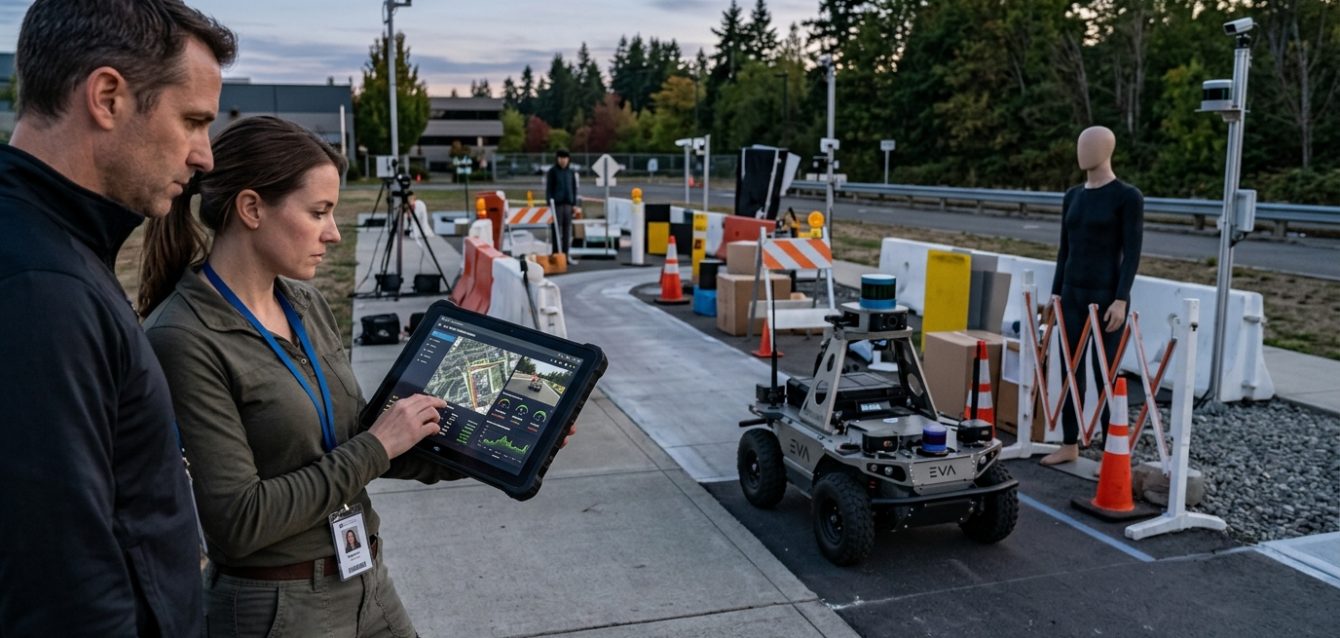
The Eval Problem: Ultimate Guide to Evaluating Real-World AI Agents 2026
Evaluating a traditional chatbot presents its own complexities, but how do you accurately grade an autonomous AI agent that takes actions over time in the unpredictable real world? The challenge of evaluating real-world AI agents extends far beyond simple success/failure flags. You contend with branching environments, accumulating side effects, and the difficulty of measuring true intent and safety.
This article addresses the genuine problem facing engineers and researchers today. You will gain a critical perspective on common evaluation pitfalls and discover advanced methodologies for robustly assessing agentic AI performance. We provide practical insights and best practices to help you move past unreliable metrics, offering a clearer path to validating your agent’s real-world efficacy.
What You Will Learn
- Identify the limitations of conventional AI agent evaluation metrics.
- Understand trajectory-based evaluation for complex, sequential actions.
- Implement sandboxed environments to simulate real-world scenarios.
- Develop comprehensive strategies for measuring an agent’s true impact and safety.
- Adopt a robust framework for continuous agent performance assessment.
A Comprehensive Guide to Robust AI Agent Evaluation
Evaluating autonomous AI agents demands more than simple pass/fail metrics. Their ability to act in dynamic, real-world environments with lasting consequences complicates assessment. To effectively evaluate autonomous AI agents, a structured, multi-faceted approach is essential.
- Define Granular Objectives: Move beyond “did it complete the task?” Break down the overall goal into measurable sub-goals, intermediate states, and expected behaviors at each step. Quantify success, efficiency, and adherence to constraints.
- Implement Trajectory-Based Evals: Assess the entire sequence of actions an agent takes, not just the final outcome. Analyze each decision point, state change, and potential side effect. This reveals *how* an agent achieved its goal, or where it erred, providing deeper insights than just the end result.
- Design Tiered Sandboxed Environments: Create controlled, simulated environments that mirror real-world complexities but allow for reproducible testing. Start with simpler scenarios and gradually introduce more variables, perturbations, and environmental noise to test resilience and adaptability without real-world risks.
- Integrate Human-in-the-Loop Validation: For subjective tasks, or to verify safety and ethical behavior, human experts must review agent trajectories. Human feedback provides crucial qualitative data that automated metrics cannot capture, especially for nuanced real-world interactions.
- Prioritize Robustness and Safety Metrics: Beyond task completion, measure an agent’s ability to recover from errors, handle unexpected inputs, and operate within defined safety parameters. Focus on minimizing negative side effects and ensuring graceful degradation rather than catastrophic failure.
Tips for Advanced AI Agent Evaluation
Assessing AI agents in complex environments requires specific strategies. These expert tips help ensure thorough and effective evaluations.
- Prioritize Observable Intermediate States: Ensure your evaluation framework can track and measure progress at key stages within an agent’s trajectory. This provides critical data, illustrating how an agent moves from one state to the next. This is central to understanding how do trajectory-based evaluations work for AI agents.
- Design for Edge Cases and Failure Modes: Deliberately create test scenarios that push agent boundaries. Include ambiguous inputs, conflicting information, and resource constraints to expose weaknesses before real-world deployment.
- Measure Side Effects and Unintended Consequences: Proactively identify and quantify any outcomes beyond the primary task. An agent might complete its goal, but create new problems in the process. Account for these impacts.
- Calibrate Human Feedback Loops Carefully: When humans provide input, clearly define criteria and use consistent rubrics. This standardizes subjective evaluation and reduces bias, making feedback more actionable for agent improvement.
- Regularly Update Evaluation Benchmarks: As agents evolve and environments change, so too must your evaluation suite. Stagnant benchmarks lead to models optimized for outdated criteria, missing current performance requirements.
Common Mistakes in AI Agent Evaluation
Many common pitfalls undermine effective AI agent evaluation. Avoiding these errors is crucial for developing robust and reliable systems.
- Relying Solely on Final Task Completion: This is a deceptively bad metric because it masks *how* an agent achieved its goal. An agent might stumble through a task with significant inefficiency or create negative side effects, yet still appear successful. Focus instead on process and intermediate states.
- Testing Only in Ideal Scenarios: Evaluating agents exclusively under perfect conditions leads to brittle systems. Real-world environments are messy. Neglecting noise, uncertainty, and unexpected events means your agent will likely fail when deployed. Test with varied, realistic inputs.
- Ignoring Long-Term Consequences: Agents operate over time. Focusing only on immediate outcomes overlooks potential cumulative negative effects or resource depletion. Always consider an agent’s impact beyond the immediate task, across multiple interactions or extended periods.
- Overlooking Subjective Performance: Some agent actions have no clear right or wrong, but depend on human preference or ethical considerations. Automated metrics alone miss these nuances. Implement qualitative human review to capture critical subjective performance data.
Final Thoughts on AI Agent Evaluation
Effectively assessing AI agents in real-world settings presents significant challenges, demanding sophisticated methodologies. Moving beyond simplistic metrics and embracing comprehensive, multi-faceted evaluation strategies is critical. Robust evaluation ensures agents perform reliably, safely, and ethically in complex, dynamic environments. Mastering the art of evaluating real-world AI agents ultimately builds more trustworthy and capable AI systems. Implement these strategies today to build better agents.
자주 묻는 질문
Q: What are the primary challenges when evaluating AI agents in real-world environments?
A: Evaluating AI agents in real-world settings is complex due to their ability to take actions over time, interact with dynamic environments, and produce side effects. The unpredictability of the real world makes it difficult to create repeatable test conditions and account for every possible scenario. This often leads to issues in attributing success or failure and measuring true agent capabilities.
Q: How do trajectory-based evaluations assess AI agent performance?
A: Trajectory-based evaluations focus on analyzing the entire sequence of actions an AI agent takes and the resulting changes in its environment over time. Instead of just looking at the final outcome, this method examines the path taken, the intermediate states, and the efficiency or safety of the agent’s decisions. It provides a more holistic view of an agent’s reasoning and adaptability throughout a task.
Q: Why is simply evaluating “task completion” often insufficient for AI agent assessment?
A: Relying solely on task completion can be a deceptive metric because it doesn’t reveal *how* an agent achieved the goal or the potential negative side effects of its actions. An agent might complete a task inefficiently, unsafely, or by causing unintended consequences in the environment. This metric overlooks critical aspects like robustness, ethical considerations, and resource utilization.
Q: When are sandboxed environments most useful for testing AI agents?
A: Sandboxed environments are crucial for initial testing and iterative development of AI agents, especially when real-world deployment poses risks or is too costly. They allow developers to control variables, simulate complex scenarios, and safely test agent behaviors without unintended consequences in a production system. These controlled settings are ideal for debugging, performance tuning, and exploring edge cases.
Q: What are effective metrics for measuring real-world AI agent performance?
A: Effective metrics for real-world AI agent performance extend beyond simple task completion to include efficiency, safety, robustness, and adaptability. Measures like resource consumption, time-to-completion, error rates, the impact of side effects, and recovery from unexpected situations provide a more comprehensive understanding. A balanced set of metrics, often including human feedback, is essential to gauge an agent’s overall utility and reliability.