

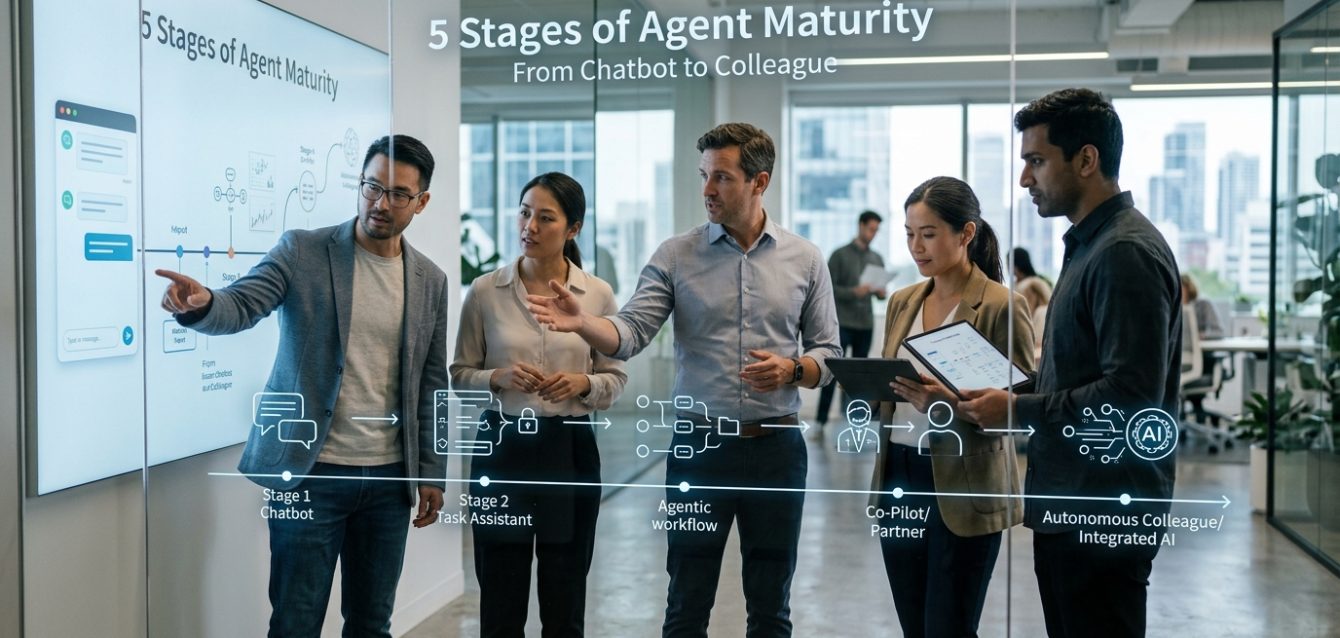
Complete Enterprise AI Agent Maturity Model 2026: From Chatbot to Colleague
Are your organization’s AI initiatives truly moving beyond basic automation, or are they struggling to deliver profound strategic impact? To genuinely harness the power of agentic AI, you need a clear understanding of its developmental arc. This article presents a complete enterprise AI agent maturity model, offering a strategic framework that details five distinct stages of evolution.
You will learn to precisely assess where your current AI systems stand, from rudimentary Q&A bots to highly intelligent, self-improving agents. We understand the significant investment and complex strategic planning required to scale AI within large organizations, often facing hurdles in integration, governance, and proving return on investment. This model provides the definitive guidance you need to plot your strategic path forward, ensuring each AI agent upgrade builds genuine capability and delivers measurable value.
What You Will Learn
- Identify the five stages of AI agent maturity.
- Assess your current AI system’s developmental level.
- Understand the specific upgrade requirements for each stage.
- Recognize common challenges in scaling agentic AI systems.
- Develop a strategic roadmap for future AI agent evolution.
A Strategic Guide to Enterprise AI Agent Maturity
Understanding where your AI agents stand is crucial for strategic growth. This guide outlines the five key stages in an agent’s journey, from basic automation to sophisticated, autonomous operations. Each stage offers distinct capabilities and requires specific development efforts.
Stage 1: Simple Q&A Bots. These agents handle predefined questions and provide static responses. They excel at straightforward information retrieval and repetitive customer queries. Their scope is narrow, focusing on immediate support.
Stage 2: Tool-Using Assistants. Moving beyond simple answers, these agents integrate with external systems. They can fetch data, update records, or initiate workflows based on user prompts. This stage marks the beginning of true interaction with existing enterprise applications.
Stage 3: Autonomous Agents. Here, agents perform multi-step tasks independently, often making decisions based on complex rules and environmental feedback. They manage entire processes, requiring less human oversight for defined functions. This stage represents a significant leap in operational efficiency.
Stage 4: Multi-Agent Systems. Multiple specialized agents collaborate to achieve larger, more complex objectives. Each agent handles a specific part of a process, passing information and tasks to others. This collaborative architecture addresses intricate problems beyond any single agent’s capacity.
Stage 5: Self-Improving Agents. The pinnacle of maturity, these agents learn and adapt from their experiences, refining their strategies and performance over time. They identify new patterns, optimize workflows, and continuously enhance their decision-making. This stage highlights truly adaptive AI. A clear guide to AI agent maturity stages helps organizations chart their path.
Tips for Scaling Autonomous AI Systems
Scaling AI agent systems effectively demands careful planning and execution. Consider these expert tips to ensure robust and successful deployment across your enterprise.
- Start Small, Think Big: Begin with well-defined, contained use cases. Prove value quickly, then gradually expand scope. This iterative approach builds confidence and allows for continuous learning.
- Prioritize Data Quality: Agents are only as good as the data they consume. Invest in clean, relevant, and comprehensive datasets for training and operation. Poor data leads to unreliable agent performance.
- Implement Robust Monitoring: Set up continuous monitoring for agent performance, error rates, and decision-making processes. Early detection of issues prevents larger operational disruptions.
- Design for Explainability: Understand how your agents arrive at decisions. Explainability is crucial for debugging, auditing, and building trust, especially in sensitive enterprise applications.
- Plan for Human-in-the-Loop: Even highly mature agents benefit from human oversight or intervention points. Design clear escalation paths and review mechanisms to maintain control and quality.
Understanding what are the stages of agentic AI maturity helps in applying these tips strategically.
Common Mistakes to Avoid
Developing and deploying enterprise AI agents comes with its share of challenges. Sidestep these common pitfalls to ensure a smoother journey.
- Overestimating Initial Capabilities: Many expect advanced autonomy too soon. Start with simpler tasks and build complexity incrementally. Define realistic expectations based on the agent’s current maturity stage.
- Neglecting Integration Planning: Failing to plan how agents interact with existing enterprise systems leads to isolated, inefficient solutions. Design comprehensive integration strategies from the outset.
- Ignoring Ethical and Governance Needs: Deploying agents without clear ethical guidelines or governance frameworks risks bias, compliance issues, and reputational damage. Establish robust policies early in development.
- Underinvesting in Iteration and Feedback: Treating agent deployment as a one-time project stifles growth. Continuously gather feedback, analyze performance, and iterate on agent design and training data.
Final Thoughts on AI Agent Maturity
Navigating the complexities of AI agent deployment requires a clear roadmap. The stages of agent maturity provide a robust framework to assess current capabilities and plan future enhancements. This structured approach helps organizations avoid common pitfalls and strategically scale their AI initiatives. Implementing a well-defined enterprise AI agent maturity model ensures you build effective, future-ready systems. Assess your systems today, and identify your next strategic upgrade.
자주 묻는 질문
Q: What are the common stages in an AI agent’s maturity?
A: AI agent maturity typically progresses through stages, starting from basic Q&A bots that respond to specific prompts. This evolves into tool-using assistants that can execute tasks, then autonomous agents capable of independent decision-making. Further stages include multi-agent systems that collaborate, and ultimately self-improving agents that learn and adapt over time.
Q: How can organizations assess the current maturity level of their AI agents?
A: Organizations can assess maturity by evaluating an agent’s capabilities, such as its ability to understand context, use tools, make decisions independently, or collaborate with others. Benchmarking against a defined maturity model helps identify current standing and future development needs. This assessment guides strategic planning for upgrades and expansions.
Q: Why is an AI agent maturity model important for enterprise strategy?
A: An AI agent maturity model provides a structured framework for understanding an organization’s current AI capabilities and defining a clear roadmap for future development. It helps align AI investments with business goals, ensuring a phased and strategic approach to enhancing agentic systems. This prevents ad-hoc implementation and maximizes return on AI initiatives.
Q: When is the right time to move towards multi-agent systems?
A: Organizations should consider transitioning to multi-agent systems when complex tasks require specialized expertise, parallel processing, or collaboration across different domains. If individual agents are becoming bottlenecks or the scope of problems exceeds a single agent’s capacity, integrating multiple specialized agents can provide more robust and efficient solutions. This approach enhances overall system resilience and performance.
Q: What frameworks can help improve an AI agent’s performance and capabilities?
A: Frameworks that focus on continuous learning, feedback loops, and performance metrics are crucial for improving AI agent capabilities. Implementing models for self-correction, tool integration, and collaboration within a multi-agent setup can significantly enhance an agent’s effectiveness. Regularly evaluating outcomes against predefined key performance indicators also provides actionable insights for iterative improvements.