
Why Your AI Forgets: Complete Guide to AI Agent Memory Architectures 2026
Have you ever had a conversation with an AI assistant, only for it to completely forget who you are or what you discussed just minutes later? This frustrating experience highlights a core challenge in artificial intelligence: the problem of memory. Understanding AI agent memory architectures is crucial for building intelligent systems that can maintain context and learn over time.
Imagine an employee who wakes up every morning with amnesia, unable to recall previous instructions or ongoing projects. This is often how AI agents operate without proper memory structures. You’ll gain clarity on why your AI forgets and discover how different memory types enable more consistent and intelligent interactions. This guide will help you understand the foundational concepts behind persistent AI memory, offering practical insights into creating more effective agents.
We’ll break down the technical complexities into easily digestible concepts, ensuring you grasp how AI agents can remember past interactions. By the end, you’ll see how robust memory systems are not just an advantage, but a necessity for truly capable AI. Prepare to learn how to move beyond an AI that starts fresh every time.
What You Will Learn
- The fundamental differences between temporary and persistent AI memory.
- How in-context memory provides immediate, short-term recall for AI agents.
- The function of external vector stores in enabling long-term knowledge retention.
- Why episodic memory is vital for an AI agent’s ability to learn from experience.
- Strategies for implementing effective memory solutions in your AI applications.
How AI Agents Use Memory Effectively
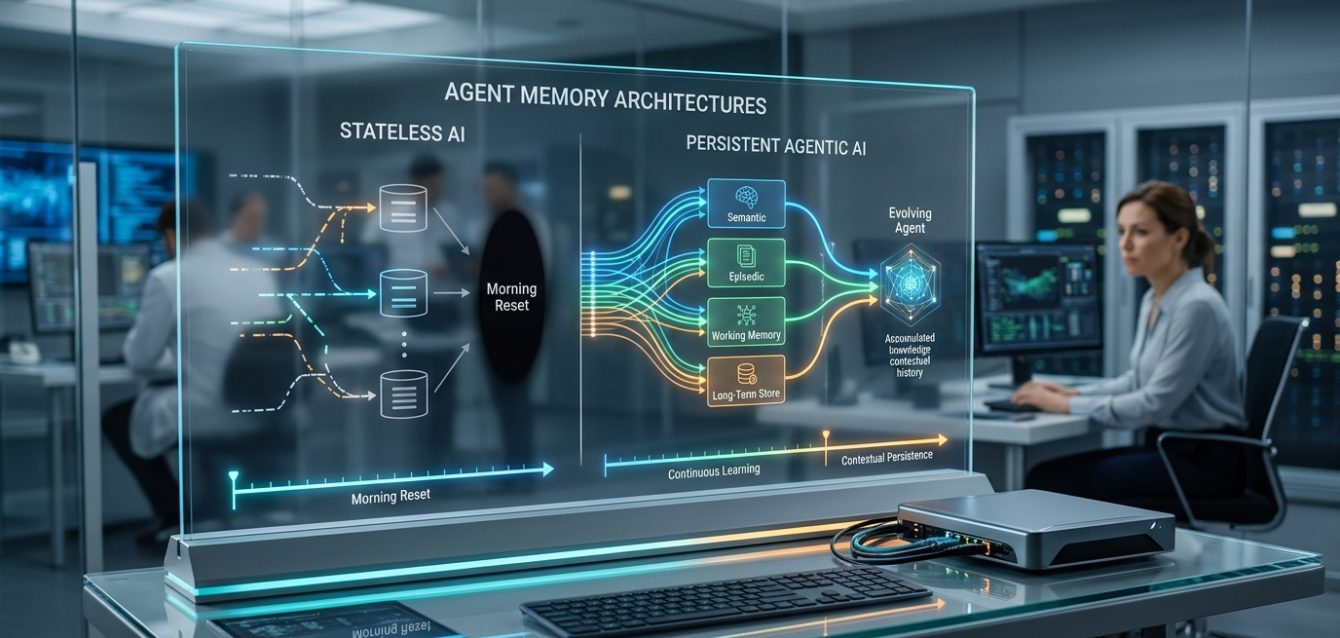
Imagine your AI agent as a brilliant employee, but one who gets amnesia every morning. They wake up knowing how to do their job generally, but recall nothing specific from yesterday’s tasks or conversations. This “forgetfulness” stems from how their memory works. Truly intelligent agents need more than just short-term recall. We need to build sophisticated memory systems to give them persistent knowledge and understanding.
Here’s how AI agents use memory to overcome this daily amnesia:
-
In-Context Memory: The Immediate Workbench. This is the AI agent’s most direct form of memory, held within its current processing window. It’s like an employee’s active working memory during a conversation – remembering the last few sentences, but only for a very short duration. This memory is temporary, clearing out after the immediate task or a certain number of interactions.
-
External Vector Stores: The Knowledge Database. For long-term factual recall, agents access external memory stores. Think of this as the company’s searchable knowledge base or instruction manual. When an agent needs information beyond its immediate context, it queries this store. The data here is converted into numerical representations (vectors) that help the agent find relevant information quickly, allowing it to pull in specific facts or general knowledge as needed.
-
Episodic Memory: The Personal Experience Log. This is where an agent remembers specific past interactions, sequences of events, and decisions it made. It’s like an employee’s personal project history or a detailed log of past client meetings. Episodic memory helps the agent learn from experience, adapt its behavior, and maintain a consistent persona across extended engagements. This allows for truly personalized and intelligent interactions.
By combining these memory types, we move beyond simple chatbots to create agents that truly learn and grow.
Tips for Improving AI Agent Memory
Building agents with robust memory requires strategic planning. Here are some expert tips to enhance your AI agent’s ability to recall and adapt:
-
Structure External Knowledge Carefully: Don’t just dump raw data. Organize your external vector stores with clear, concise information chunks. High-quality embeddings are crucial; they ensure the agent retrieves the most relevant information efficiently when it needs to remember specific facts.
-
Implement Intelligent Summarization: For long-running agents or complex tasks, summarize past interactions and condense them into key takeaways before storing them in episodic memory. This prevents memory bloat and helps the agent focus on salient information.
-
Contextualize Retrieval Queries: When should AI agents use vector databases? Always when long-term, factual recall is needed. Frame your retrieval queries from the agent’s current task or goal to ensure it pulls the most pertinent information from external stores, rather than generic data.
-
Prioritize Memory Decay Strategies: Not all information needs to be remembered indefinitely. Design mechanisms to let less important memories naturally “fade” or be prioritized lower over time. This helps the agent maintain focus on current and relevant data, avoiding information overload.
-
Design for Incremental Learning: Allow the agent to update its external and episodic memory over time based on new interactions and feedback. This fosters continuous improvement and adaptability, making the agent more effective with each experience.
Common Mistakes to Avoid
Developing AI agents with effective memory systems can be tricky. Here are some pitfalls to steer clear of:
-
Over-reliance on In-Context Memory: Believing an agent can remember everything important within its immediate processing window is a common error. This leads to agents forgetting crucial details from one interaction to the next. Always plan for external and episodic memory for persistent understanding.
-
Unstructured External Knowledge: Simply feeding vast amounts of disorganized text into an external vector store makes retrieval difficult and often irrelevant. Instead, segment and pre-process information into meaningful chunks to ensure the agent can find what it needs efficiently.
-
Ignoring Episodic Memory for Consistency: Neglecting to track past interactions means your agent will act as if it’s meeting you for the first time in every conversation. This prevents personalization and a consistent user experience. Store relevant interaction history to build a persistent relationship.
Final Thoughts on AI Agent Memory Architectures
Building AI agents that truly understand and adapt requires a thoughtful approach to memory. Moving beyond a simple conversation window, we empower agents with long-term recall, factual knowledge, and experiential learning. Understanding the distinct roles of in-context, external, and episodic memory allows you to design agents that are more intelligent, more personal, and far more useful. Mastering these AI agent memory architectures is key to unlocking the full potential of your AI. Start building more intelligent agents today.
Frequently Asked Questions
Q: What is episodic memory in AI agents?
A: Episodic memory in AI agents refers to their ability to recall specific past events, interactions, and experiences in a temporal sequence. This allows agents to learn from their own operational history, understanding how previous actions led to certain outcomes or changes in state. It contributes to more consistent and personalized behavior by building a cumulative understanding of past engagements.
Q: How do AI agents achieve long-term memory?
A: AI agents achieve long-term memory by storing information outside their immediate processing context, typically in persistent knowledge bases or specialized data structures. This often involves converting information into a format that can be efficiently indexed and retrieved, such as using vector embeddings. This external storage allows agents to access vast amounts of information that extends beyond their current interaction window.
Q: Why do AI agents forget context?
A: AI agents often forget context because their “in-context” or short-term memory has a finite capacity. As new information or turns in a conversation are processed, older information eventually exceeds this limit and is no longer directly accessible. This limitation requires strategies to retrieve relevant historical context when needed, preventing the agent from starting fresh in every interaction.
Q: When should AI agents use vector databases for memory?
A: AI agents should use vector databases when they need to store and retrieve large quantities of unstructured or semi-structured information based on semantic similarity. This is ideal for external knowledge bases, user preferences, or past conversation summaries that need to be recalled efficiently and contextually. Vector databases enable agents to find relevant memories even if the exact keywords are not present in the query.
Q: Which memory architectures are best for AI agents?
A: The best memory architecture for an AI agent depends on its specific purpose, tasks, and the nature of its interactions. Most effective AI agents employ a hybrid approach, combining short-term “in-context” memory for immediate reasoning with external long-term memory solutions like vector databases or knowledge graphs. Some also incorporate episodic memory for recalling specific event sequences. A layered architecture that balances these components is often optimal.